
St. Lawrence County Court Records After Arrest
A jail booking record is not the same thing as a criminal court case. After a St. Lawrence County arrest, the person may be booked into the St. Lawrence County Correctional Facility run by the Sheriff's Office under Sheriff Patrick R. "Rick" Engle, brought before a local criminal court for arraignment, and then prosecuted by the St. Lawrence County District Attorney or another prosecutor when jurisdiction requires it. The District Attorney's Office says it prosecutes all criminal cases in St. Lawrence County and appears in County Court, Supreme Court, Family Court, and 36 city, town, and village courts.
The court record starts with court paperwork, not with the jail roster. For custody and booking status, use St. Lawrence County jail inmate records. For booking photos, use the St. Lawrence County jail mugshots page. For filed charges, hearing dates, felony filings, local court dockets, and dispositions, use WebCriminal, the County Clerk, the local court of arraignment, or the Office of Court Administration criminal-history route.
Search Court Records After a St. Lawrence Arrest
The first public online court route is New York Unified Court System WebCriminal. WebCriminal is useful for selected pending criminal cases and future court appearances. It is not a full archive of every old St. Lawrence County criminal file. A defendant search can show active calendar information, court, docket or case identifiers, and charges when the matter is covered by the portal.
- Confirm the person's custody status through VINELink or the correctional facility if the arrest is recent.
- Identify the arresting agency, arrest date, and arraigning court when that information is available.
- Open WebCriminal and search by defendant name, case identifier, or court calendar.
- Read the charge list, court, case number, and next appearance date with care.
- For felony convictions or Supreme and County Court filings, contact the St. Lawrence County Clerk.
- For misdemeanor, violation, town, village, or city court matters, contact the local court where the case is pending.
- For an official statewide name-based criminal-history product, use OCA CHRS.
The captured WebCriminal search page shows the main case-search routes: Case Identifier, Defendant, and Court Calendar.
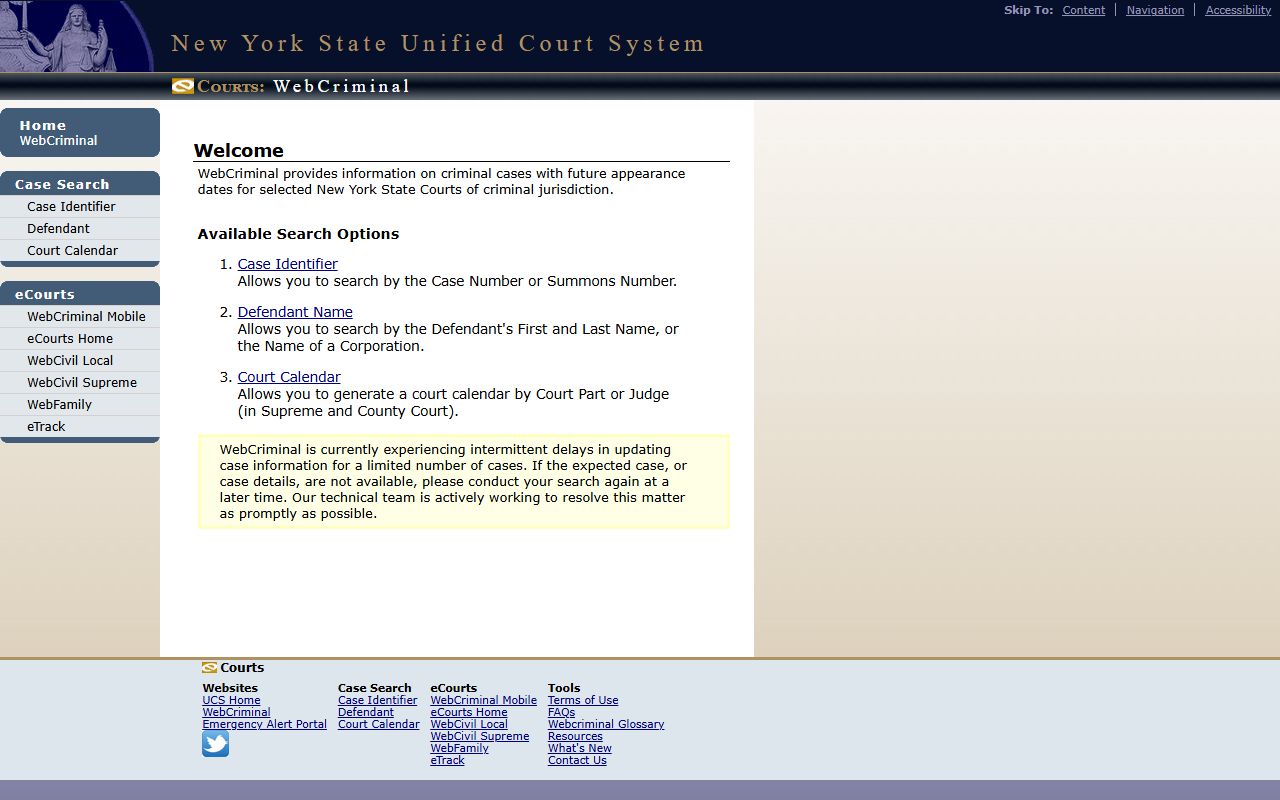
Use WebCriminal for pending case timing, then confirm closed, sealed, felony, or local-court documents through the court or clerk that holds the file.
St. Lawrence County Court Search Fields
WebCriminal search fields depend on the route selected. A case-identifier search works best when a docket, indictment, summons, or other court number is known. A defendant search is common right after an arrest, but names can be misspelled, abbreviated, or entered differently from the jail record. Calendar searches help when the court and future date are known.
| Field Label | Type | Required | Options / Format Notes |
|---|---|---|---|
| Case Identifier | Tab or route | Conditional | Use when a case, docket, summons, or indictment identifier is known. |
| Defendant | Tab or route | Conditional | Search by defendant name for covered criminal matters. |
| Court Calendar | Tab or route | Conditional | Use court and date when the appearance date is known. |
| Defendant Last Name | Text | Yes for name search | Exact label can vary after portal conditions are accepted. |
| Defendant First Name | Text | Varies | Narrows a name search. |
| County / Court | Dropdown | Usually required | Choose St. Lawrence or the applicable criminal court if exposed. |
| Calendar Date | Date | Calendar route | Used for future court-date searches. |
St. Lawrence County Clerk and Local Courts
The St. Lawrence County Clerk court records page says criminal proceedings may be initiated by an attorney, a local court, or the District Attorney. It also states that Supreme and County Courts file criminal records at the County Clerk's office and that only felony convictions are filed there. The County Clerk is at 48 Court Street, Canton, NY 13617, and the listed phone is 315-379-2237.
Local criminal court matters may begin in a city, town, or village court. That matters in St. Lawrence County because the District Attorney covers 36 city, town, and village courts in addition to County Court and Supreme Court. A misdemeanor or violation may not be found at the County Clerk if the case is still in the local court. A felony may begin locally and later move toward County Court or Supreme Court.
The official County Clerk court records source identifies the Supreme and County Court filing scope for criminal matters.
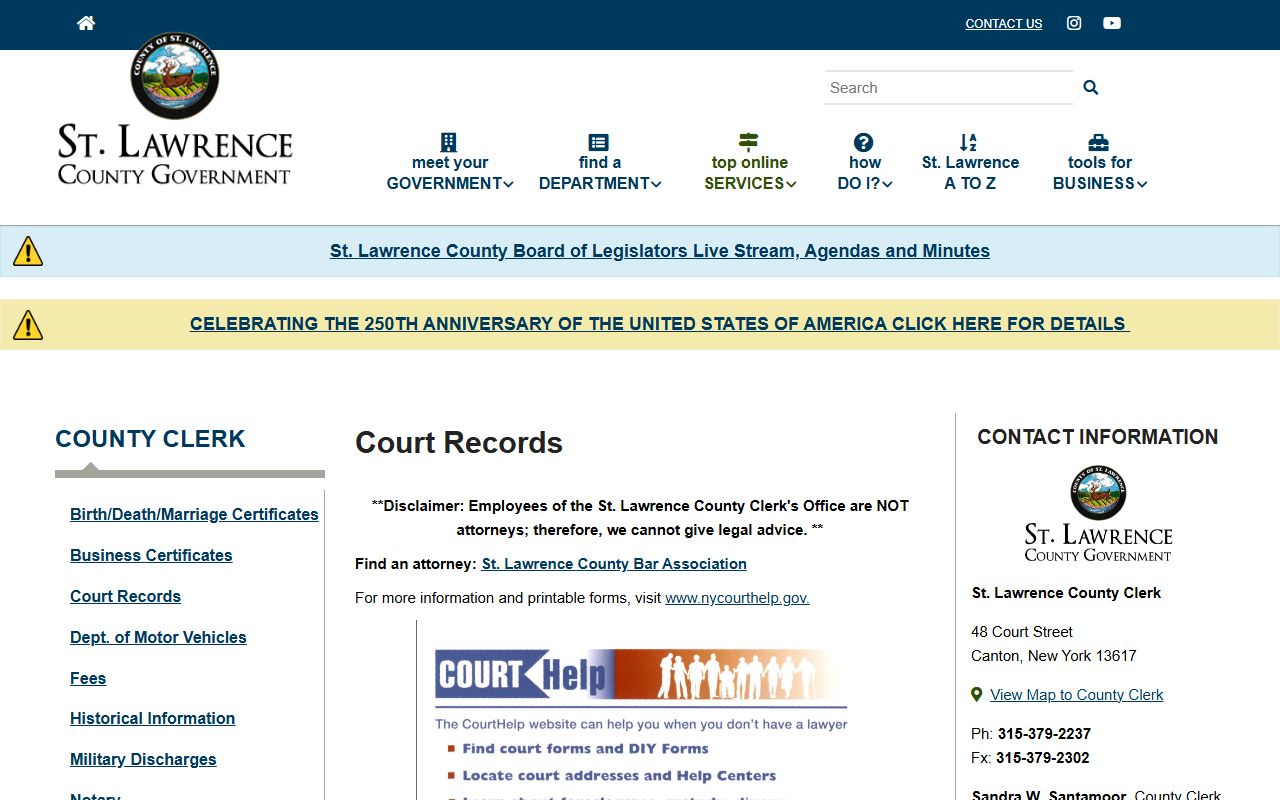
The clerk route is strongest for filed superior-court records and felony convictions, while local courts remain the practical route for local criminal cases that have not moved upward.
Charging Documents After a St. Lawrence Arrest
After a St. Lawrence County jail arrest, the arresting agency supplies paperwork and allegations. The District Attorney reviews and prosecutes criminal cases. The court-filed charge can differ from the booking charge that appeared at intake. The difference is normal because the prosecutor may amend, reduce, add, dismiss, or supersede charges as the case moves from local court toward a final disposition.
| Document | Who Uses It | What It Does |
|---|---|---|
| Complaint | Local criminal court route | Accusatory instrument that begins a local criminal case. |
| Information | Local criminal court route | Formal charging instrument used in local criminal court. |
| Indictment | Grand jury / superior court route | Grand-jury charging document for felony prosecution in superior court. |
Note: A jail booking charge is an accusation tied to custody, not a conviction or final court disposition.
St. Lawrence County Charge Status
Charge status changes as the court record moves forward. A pending charge has not reached a final outcome. An amended or reduced charge means the filed accusation has changed. A dismissed charge ended without conviction. A conviction is the result of a guilty plea, verdict, or other formal finding of guilt. The court record, not the jail roster, is the source for disposition.
| Status | What It Means | Where to Verify |
|---|---|---|
| Pending | The case or charge has not reached final disposition. | WebCriminal, local court, or clerk. |
| Amended / Reduced | The charge changed after filing through prosecutor or court action. | Court file or clerk entry. |
| Dismissed | The charge or case ended without conviction. | Court disposition record. |
| Superseded by indictment | A superior-court indictment replaced or changed the lower-court charge path. | County Court, Supreme Court, or County Clerk. |
| Convicted | A plea, verdict, or formal finding produced guilt on a charge. | Disposition record or OCA CHRS. |
Bond and Court Records After Arrest
Bail and release decisions are court functions, even when payment is handled through the jail. St. Lawrence County accepts bail 24 hours a day by cash, credit card, or bail bond when bail is set and payable. The facility does not accept checks or money orders. A person posting bail in person needs photo identification, and the credit-card holder must be present if paying by card in person.
| Release Type | How It Works in the Record |
|---|---|
| Cash bail | Money paid when the court sets payable bail and release is otherwise allowed. |
| Credit-card bail | Processed through GPS/GovPayNet procedures described by the county. |
| Bail bond | Handled through the courts; the jail receives a court-ordered release. |
| Recognizance or non-monetary release | Court order controls release without a jail payment. |
| Hold or detainer | Another court, warrant, agency, parole matter, federal hold, or ICE detainer may prevent release. |
Warrants Before a St. Lawrence Arrest
The Sheriff's Office publishes a Warrant Alerts / Most Wanted page. It asks the public for help locating people with warrants and directs tips to 315-379-2222. The page says information can be anonymous. It is not a full statewide warrant database, and no formal search fields were visible in the static capture.
A warrant can become a jail booking when law enforcement locates the person, receives commitment or hold paperwork, and transports the person to the correctional facility. Bench warrants can come from local courts, County Court, or Supreme Court. A warrant tied to a pending case may also appear through WebCriminal or the issuing court's calendar, but resolving a warrant should be handled through counsel or the court that issued it.
St. Lawrence Charges vs Convictions
An arrest and charge do not prove guilt. A booking record shows why the person was received into custody or committed to jail. A charge is a filed accusation. A conviction is a final result after a plea, verdict, or other formal court finding. The distinction is important for court records after a jail arrest because public search results may show an accusation long before any final disposition exists.
| Point of Comparison | Charge | Conviction |
|---|---|---|
| Stage | Accusation after arrest or court filing. | Final finding or plea on a charge. |
| Proof level | Filed based on legal allegations. | Requires guilty plea, verdict, or other formal disposition. |
| Can change | May be amended, reduced, dismissed, or superseded. | May lead to sentence, appeal, sealing eligibility, or other post-disposition action. |
| Where to verify | WebCriminal, local court, DA or clerk route. | Disposition record, County Clerk where filed, or OCA CHRS. |
Sealed and Expunged Arrest Records
New York commonly uses sealing rules for criminal records, and the research did not support a broad promise that every arrest can be expunged from all systems. The County Clerk page says sealed records may be accessed only by parties involved or their counsel. New York Criminal Procedure Law 160.50 requires records to be sealed after a criminal action terminates in favor of the accused and generally requires photographs and fingerprints tied to that action to be returned or destroyed unless a court orders otherwise.
| Record Treatment | Plain Meaning | St. Lawrence County Route |
|---|---|---|
| Sealed | Hidden from normal public access, with limited access for parties, counsel, or authorized users. | Contact the court or counsel; do not expect WebCriminal or the clerk counter to show a sealed public file. |
| Expunged | Often used by the public to mean erased, but New York research here supports sealing and return/destruction rules for favorable termination. | Verify with the issuing court, counsel, or statute-specific process. |
| Redacted | Part of a record is withheld for privacy, safety, juvenile, medical, victim, investigative, or statutory reasons. | Use the FOIL denial or court response to understand the reason. |
OCA CHRS and Public Access
For a statewide criminal-history search, the New York court system offers Office of Court Administration Criminal History Record Search, known as OCA CHRS. The research lists the court system fee as $95 and notes that CHRS is an exact-match name and date-of-birth search. Name or DOB variations are not reported. CHRS is different from WebCriminal, which is aimed at selected pending criminal cases and future appearance information.
New York Public Officers Law section 87 makes many agency records presumptively available unless an exemption applies. Public access is not unlimited. Sealed cases, youthful offender records, juvenile records, medical and mental-health information, victim information, safety-sensitive material, and records that would interfere with law-enforcement proceedings may be withheld or redacted.
Important: Court, jail, and criminal-history records should not be used for FCRA-covered decisions without a compliant consumer-reporting process.
St. Lawrence County Prosecutor Contact
The St. Lawrence County District Attorney is Gary M. Pasqua. The office is listed at 48 Court Street, Canton, New York 13617, with phone 315-379-2225 and fax 315-379-2301. The DA page states that the office represents the People of the State of New York and the People of St. Lawrence County in criminal proceedings, safeguards victims' rights, and seeks justice ethically.
The DA may be relevant when a court records after arrest search needs the prosecution source for charge filing, but public record copies still come from the court, the County Clerk, or another records custodian. The county VINE page also notes that a prosecuting District Attorney may provide NYSID or date of birth for VINE registration in appropriate victim-notification contexts.